

Jax State students participate in National Constitution Center’s inaugural preservice teacher workshop
10/02/2026
By Brett Buckner
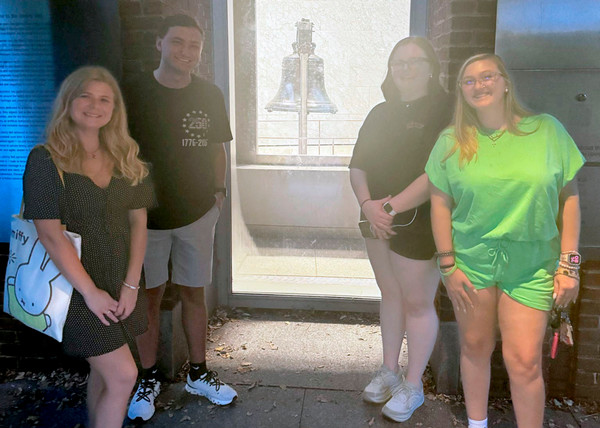 Four Jacksonville State University (Jax State) senior secondary education students joined peers from across the country for the National Constitution Center’s inaugural preservice teacher professional development workshop in Philadelphia this summer.
Emma Brown, Elijah Cantrell, Jaidyn Gossett and Jasmine Gillis participated in discussions about ways to strengthen civic learning in classrooms, an opportunity that reshaped how they view teaching, civic education and their own futures as educators.
Being surrounded by peers who shared that passion, many from flagship and private universities, reinforced Brown’s confidence that she belongs in national conversations about civic education.
“Hearing different opinions on topics and having civil debates with people from different backgrounds was a wonderful experience,” she said. “We all had common ground in loving history, but we all wanted to further our education more.”
Brown said she plans to carry that experience into her future classroom.
“I will apply this in my own life and future career,” she said. “I want my students to listen to each other but also have their own opinion in a civic discussion.”
Participants heard from experts who devote their careers to supporting future teachers. Among them was Ralph Young, a professor of history at Temple University, who discussed dissent throughout American history and left the students with a memorable insight: “History does not repeat itself, but it often rhymes,” Brown recalled.
“I acted like a sponge and absorbed all that they had to say,” she said. “This scholarly talk opened my eyes immensely to the idea that we must teach the whole truth of history, not just the parts we want.”
Historically, the National Constitution Center (NCC) has not worked specifically with preservice educators. But as organizers built connections with teacher preparation programs across the country, they recognized a need. Many future educators were seeking reliable resources and strategies they could implement as soon as they entered the classroom, explained Ryan Beaudoin, professional learning specialist for the NCC.
“We knew that providing something specific and targeted for those who are yet to begin their careers would have a far greater impact,” Beaudoin said.
With that in mind, the NCC designed the program differently from its typical professional learning events.
“Typically we have multiple scholars speak, and the focus is on providing as much content as we can,” he said. “For this program we had a strong application focus, and chose our partner organizations to reflect that.”
The Jack Miller Center partnered with the NCC to provide classroom strategies for teaching the Declaration of Independence. The Federal Reserve Bank of Philadelphia also participated, offering strategies for teaching financial literacy in the classroom. Sessions included contemporary sources demonstrating the lasting impact of the Declaration.
The breadth of the program was intentional, Beaudoin said.
“It seems a bit disconnected at first,” he said, “but we know that these teachers do not yet know exactly what they will be teaching, and we had participants who were focused on everything from early childhood education all the way to juniors and seniors in high school.”
For Jasmine Gillis, the scope of the program was one of its strengths.
“On a basic level, this exposure was extremely impactful in providing me with resources to use in my classroom, teaching strategies to utilize, and connections with other teachers who are also starting their careers,” she said. “For my future career, this opportunity allowed me to consider how I could teach American history in a way that is both relevant to students and covering all standards.”
Gillis said the trip began with a memorable first day in Philadelphia, where participants were given time to explore sites including Independence Hall and Chinatown.
The following day, preservice teachers were introduced to strategies and resources they could use in their classrooms.
“For example, so many teachers are reluctant to teach economics because of how complicated it is for adults, much less for children,” Gillis said. “The Constitution Center had a guest speaker who gave a micro-teaching lesson on economics and provided us with websites that included lessons … it truly relieved the most stressful aspect of teaching: not knowing where to start.”
The NCC’s immersive environment brought history to life, said Elijah Cantrell.
“In this building, you get to experience what it was like to be there when they signed the Constitution,” he said. “They also took us to different museums within the building as well as taught us different methods and pedagogies on how to teach the Constitution.
“This will better me when teaching the future generations on the foundations of America.”
Learning alongside students from across the country who all aspire to become teachers was equally impactful, Cantrell said.
“It changed my whole perspective on what it means to be a teacher,” he said. “My passion is to help kids and young adults learn the importance of our nation as well as learn important life skills.”
The workshop also reshaped Gillis’ understanding of what it means to be part of a teaching community.
“Beforehand, I had this idea that I was going to plan everything exactly perfect for my class,” she said. “While ultimately, I will be responsible for planning, there is a world of resources out there to relieve the burden. For me, being a teacher has always been managing and teaching your own class. Now, being a teacher isn’t just managing and teaching your own class; it’s also helping and uplifting other teachers.”
The NCC program offered practical tools and resources that Gossett intends to bring into her future classroom.
“This exposure provided a sense of professional development,” she said. “It has opened my eyes to how many resources are available to teachers. I am appreciative of Ryan and the other faculty at the NCC for caring so deeply about the future educators.”
Dr. Benjamin Gross, director of Jax State’s Center for Leadership and American Principles (CLAP), said the partnership between Jax State and the NCC solidifies the university’s reputation.
“This partnership is a perfect example of what CLAP providing unique opportunities for Alabama,” Gross said. “By connecting Jax State with the NCC, CLAP opened opportunities for our students that would not otherwise exist. The relationship allows nationally recognized organizations to discover the exceptional future educators being trained at Jax State while giving our students access to experiences found nowhere else in Alabama. It is one more way CLAP makes Jax State a unique destination for students interested in civic education and leadership.”
It is a collaboration that stands out nationally.
“This type of cooperation – between a civic center, College of Education and Professional Studies, and national civic education organization – is something no other university in the civics renaissance has achieved,” he said, “which makes us not just a leader in Alabama but in the entire nation.”
The impact of this event extends beyond the four students who attended.
“Jax State students showed a national audience of students from other states and prestigious universities that Alabama has dedicated, intelligent, and caring future educators,” Gross said. “CLAP is helping a national audience to see how Alabama is a leader in civic education, which further demonstrates our Center’s importance to the state’s goals.”
Experiences like those sponsored by the NCC help teacher candidates see their preparation as extending beyond coursework, said Dr. Brandon Gilliland, chair of Jax State’s Ed.D. program and co-director of CLAP.
“They are introduced to high-quality resources, practicing professionals, and approaches to teaching civic and historical content that they can carry into their own classrooms,” he said.
Gilliland added that the long-term value for students is substantial.
“They gain greater confidence in their content knowledge, see practical models for engaging students in complex issues, and begin building a network of organizations and professionals they can draw upon throughout their careers,” he said. “It also gives them something meaningful to discuss during interviews because they can explain how the experience influenced their instructional thinking.”
Gilliland was especially impressed with how seriously the students engaged in the activities.
“Opportunities like this expose future teachers to perspectives and resources they may not encounter through their regular coursework,” he said. “The greatest value will come when they take what inspired them and translate it into thoughtful classroom practice.”
For Brown, one of the most important lessons was the value of approaching difficult topics without preconceived notions and listening to others before responding.
“Civil discourse is something that needs to be implemented in all classroom types, but especially from a social studies standpoint,” she said. “To have your own educated opinion on topics, not just because others say so. Teachers need to make their classroom an open space for students to grow and listen to each other.
“I will carry that into my future classroom and as a person, too.”