

Dr. Benjamin Gross participates in international civic education conference in Germany
10/02/2026
By Brett Buckner
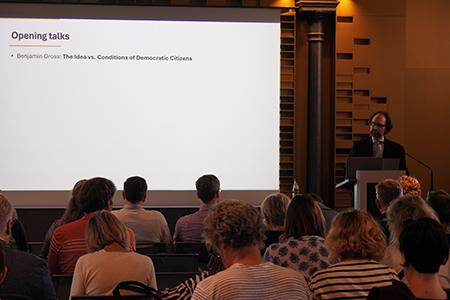 Dr. Benjamin Gross recently served as a guest speaker and participant at the Fostering U.S.-Euro Democratic Resilience in Civic Education (FEUR) conference in Germany. The symposium was part of an international collaborative initiative and conference series that brought together scholars, experts, and practitioners from the United States, Canada, Germany, Austria, and Switzerland to address contemporary challenges facing Western democracies through civic education.
“My invitation ensured that a voice from Alabama, a voice outside the coasts and from the South, was present in this important work that will shape the future,” said Gross, Director of Jacksonville State University’s Center for Leadership and American Principles. “As a collaborator in this arena, I brought forth the foundational principles of American government and Western Thought as core to the civics renaissance.”
The project was born out of a cross-national partnership co-created by Thinking Nation and the Institute of Didactics of Democracy at Leibniz Universität Hannover. The goal was to discuss current challenges and perspectives of civic and political education in democratic societies, including the challenge of democratic backsliding, from a comparative perspective.
FEUR included participants from Harvard University, Bill of Rights Institute, and CIRCLE at Tufts University, among other national and international educational institutions.
“It was heavy hitter, after heavy hitter, after heavy hitter,” Gross said. “And I guess that means Jacksonville State is a heavy hitter, too. That's one of my main takeaways..”
Dr. Gross was asked to give the opening presentation and was one of only four featured speakers across the three days.
“I was humbled and honored,” Dr. Gross said. “They allowed me to set the agenda.”
During the summit, German high school students were invited to share their views on democracy.
“The job there … was not to talk,” Gross said. “We were not there to lecture. We were not there to inform. We were just there to hear their answers to questions: ‘What makes you optimistic about democracy? What are you fearful about democracy? What do you think the future is going to be?’ We were just there to listen and learn.”
Some students recognized the name Jacksonville State University.
“They came up to me and said, ‘Oh, now you are the person from Jacksonville State University,’” Dr. Gross said. “I said, ‘Okay." And they said, ‘You guys have that amazing marching band … the Marching Southerners.’"
The international dimension of the summit provided both challenges and benefits, allowing participants to distinguish context-specific issues from common cross-national themes.
“It was very insightful and enlightening the way we respected each other’s ideas,” Gross said. “We all did as much listening as we did speaking.”
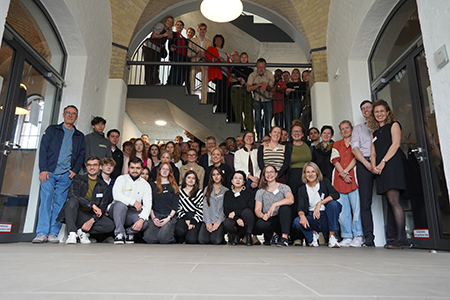 The group is now working on a white paper. It decided this document will include disagreements and multiple perspectives.
“I think one of the best things that came out of this was that whatever we produced doesn't have to be a uniform statement,” Dr. Gross said. “There is room for dissent, for disagreement, for concurrence, for multiple perspectives. We can show even in the white paper the messiness of collaboration, of democracy, of working together.”
A follow-up meeting is planned in North America during 2027 with the goal of moving from identifying problems to proposing solutions.
“The diverse approach is a beautiful thing because it engages with the complexities of democracy,” Dr. Gross said. “It understands from the very beginning that the thing we are working with is not a one-size-fits-all, and so we're going to have to put different ideas on the table and have those different ideas compete with each other to figure out what the best options are.”