

Local Artist's Commissioned Angle Hall Rendering Becomes Centerpiece of President's Office
09/17/2026
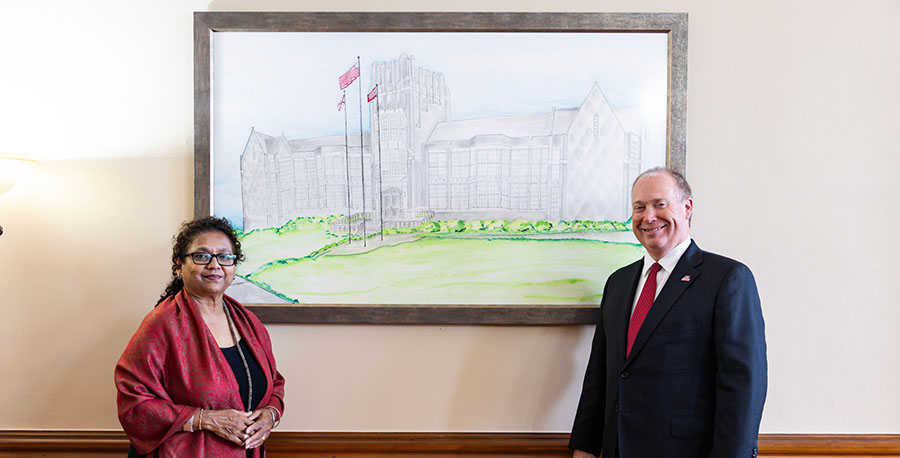
Local artist Nanda Patel's commissioned work joins two mixed-media pieces in a collection celebrating Jax State's history, architecture and mission.
By Brett Bucker
The first time Nanda Patel and Jacksonville State University President Dr. Don Killingsworth crossed paths, they were strangers working toward the same goal.
In the aftermath of the EF-3 tornado that struck the Jax State campus on March 19, 2018, causing more than $35 million in damage, Patel donated approximately 130 hotel rooms' worth of furniture as the University worked to house displaced students. Among the volunteers loading dressers, televisions and other furnishings into flatbed trucks and rental vans was Dr. Killingsworth, then Jax State's chief external affairs officer, working alongside students to help the campus recover.
Patel didn't know who he was.
“He never introduced himself,” said Patel, who only realized years later how they’d first met. “I didn't know who he was. Of course, there was a lot going on at the time.”
Years later, their paths crossed again under very different circumstances. Dr. Killingsworth was now President of Jax State, and Patel had become known not only as a local business owner but also for her work as an artist.
 In an artist statement for an ongoing show at Gallery@808 in Gadsden, Patel describes herself as “an ethnic folk artist whose mixed-media work is shaped by a life lived across cultures and continents.” Born in Kenya to British Indian parents, Patel experienced early displacement during Africanization, moving to India, then London, before eventually settling in the United States.
Patel recently exhibited her work at the Dr. William R. Harvey Museum of Art at Talladega College and Gadsden State Community College. She is also tentatively scheduled to exhibit at the Birmingham Public Library, Lowe Mill ARTS & Entertainment in Huntsville and the Mary Hardin Center for Cultural Arts in 2027, followed by the Carnegie Visual Arts Center in 2028.
Around 2024, Dr. Killingsworth saw some of Patel's work on Facebook, pieces that reflected both her global upbringing and the technical precision shaped by her background in physics.
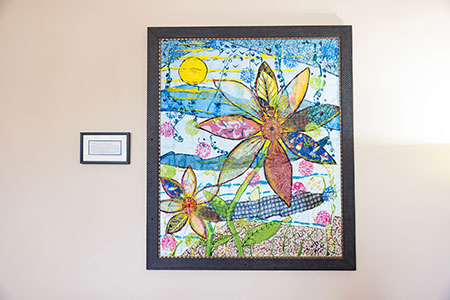
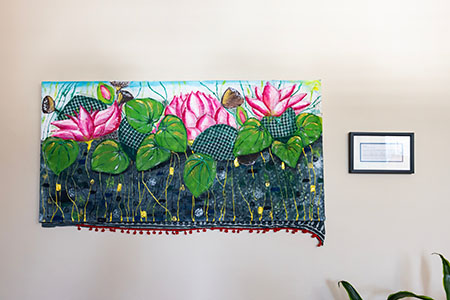
Intrigued by her work, Dr. Killingsworth eventually visited Patel’s home studio where he was particularly impressed by two pieces - The Diverse Earth and The Pond – that would one day hang in his office. Both were deeply personal, rooted in Patel’s philosophy that art is not simply decorative but emotional.
The Diverse Earth incorporates fabrics from Kenya, India, and America to form a flower, “symbolizing that while the Earth and sun are one, people are different,” Patel explained. “Each cultural situation supports the flower, representing diversity and the pillars of education,” Patel explained.
For The Pond, Patel used five different cotton saris in a collage layered with acrylics. Patel describes the piece as a “meditation on the muck and messiness from which beauty grows.” Having owned and operated motels for more than 20 years, Patel said the work reflects her belief that every member of a workforce contributes to the success of an organization, represented by lotus flowers growing from the muck in which they are planted.
“The muck is as important as the top few lotuses,” she said. “Recognizing everyone that put effort in the success of any situation is important.”
Together, the two pieces reflected themes of education, growth and service. Dr. Killingsworth saw an opportunity to add something specifically connected to Jax State.
To that end, he commissioned Patel to use her skills to create a rendering of Angle Hall.
“Angle Hall is one of the most recognizable and historic buildings on our campus, and I wanted a piece that captured what makes it so special,” Dr. Killingsworth said. “Ms. Patel has a unique style and an incredible attention to detail, and I thought her work would lend itself well to something that celebrates the history and character of Jax State.”
‘Commission means placement’
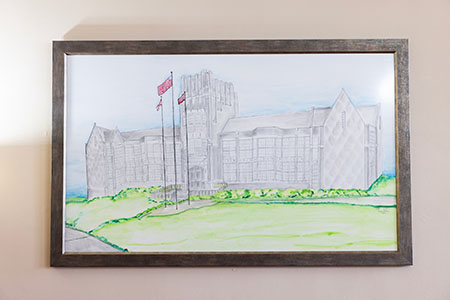
Stoic and steeped in university history, Angle Hall – formerly Bibb but renamed in January 2021 in honor of alumni Marcus and Mary Angle – is one of Jacksonville State’s most recognizable structures. But Dr. Killingsworth didn’t want a painting. He wanted a rendering that captured the building’s architectural spirit.
 Patel remembers the request clearly.
“I can draw anything,” she said. “The concept of Angle Hall was all [Dr. Killingsworth’s]. The agreement was mine, and I said, ‘I’ll give you everything you want.’ The medium he chose, he liked the pencil kind of look with the watercolors, and it was very gradual just looking at the details.”
Before Patel could begin, she needed to see where the two loaned pieces and the commissioned Angle Hall rendering would ultimately hang.
“We spent several hours together on a very cold fall day,” Patel said. “I met him at Angle Hall, and he showed me the space. I took photos of the room and thought we need to give this a cleaner look. Then he gave me a tour around his home where he has art, and he stood on the side of Angle Hall as I clicked away.”
Patel would return to Dr. Killingsworth’s office several more times, photographing, measuring, and studying the room’s dark tones, knowing the piece had to stand out rather than disappear into the shadows.
“Commission means placement,” Patel said. She means it literally.
“Where’s it going? Let me see the wall. Can I measure it?” she said. “Commission includes the whole thing. Where? How? What? How long will it be there? What do you want to feel from it when you’re done?”
Patel chose every detail - the frame, the matting, and the glass.
“Finally, when the decision was made, it was going to be around six feet,” she said. “I had to get the right paper because it had to be multi-medium. It's a mixed medium. It's got watercolors and pencil and charcoal on it.”
But there was one requested change to the iconic view.
“[Dr. Killingsworth] said, ‘I don't want the fountain in the front,’” Patel said. “And that just enlightened me on his concept. Because he says he's not an artist, I felt what he felt.”
Geometry, precision, and lots of daylight
Patel’s home sits on a hilltop with large windows that flood the dining room with natural light. That room became her main workspace for creating Angle Hall. She taped a massive sheet, nearly six feet long, to her dining table and refused to move it for the entire eight‑week process. Her grandchildren were banned from the room, and her family simply ate elsewhere.
“Nobody could touch it,” she said. “No one came over for dinner. Nobody. And I could only draw on it during daylight.”
The work itself was as trying as it was rewarding.
“Angle Hall’s symmetry was unforgiving,” Patel said. “Its windows, angles, and towers demanded mathematical precision.”
Patel has a background in physics, something her father insisted on instead, which was invaluable.
“It was a lot of ruler work,” she said. “A lot of it was perception. It was geometry at the highest level.”
The left tower proved to be the greatest challenge.
“That perspective was a tough cookie,” she said, laughing. “My rulers were not long enough and I’m trying so hard. And then I’d stand on a chair and take a photo from the top and look at it.”
She refused to lift the piece until she was finished. The paper was too delicate, the risk of smudging too great. Her emotional paintings, such as The Pond and The Diverse Earth – were created upstairs in a studio full of saris, splattered paint, and creative chaos.
“Painting is upstairs,” she said. “It’s a messy table because that’s where I let the paint just go.”
 Angle Hall required a different approach.
“It was very concise,” she said. “It was precise timeliness. I would dress up. I would sit down. My hands were always clean because I was terrified it would smudge.”
In February when Angle Hall was complete, Patel had her husband hold it upright so she could photograph it. She was very proud of the end result.
“It is not a painting,” Patel said. “It's actually Angle Hall's details. I've lived in England. I'm very fond of history, of castles. So, that look and that amazing centerpiece, if you look at the details, that is some amazing work. Even I am amazed.”
Dr. Killingsworth offered to send someone to pick it up, but Patel refused.
“Nope,” she said. “I get anxiety stricken when I think about a car crash. My painting was in the back. When it has to go from point A to B, I’m going to be the one to make sure it gets there safely.”
She drove it directly to Birmingham for framing, then straight to Dr. Killingsworth’s office.
“I lifted it myself, walked right in and said, ‘I am done. It is yours now.’”
Angle Hall now hangs above a conference table in the President's Office, flanked by The Diverse Earth and The Pond.
“Now you put the three together,” Patel said, “it’s like the pillars of education.”
For Patel, completing the Angle Hall rendering was a significant accomplishment.
“I will never do a second to Angle Hall,” she said. “It’s very stoic, but I had to give it a life. It’s made for that particular space and gives it that aura.”
“The President’s Office is a place where we welcome students, alumni, employees, community members and visitors from across the state and beyond,” Dr. Killingsworth said. “I want it to be a space that reflects who we are as a University. These pieces help us do that while showcasing the work of a talented artist from our own community.”