

Library Instruction
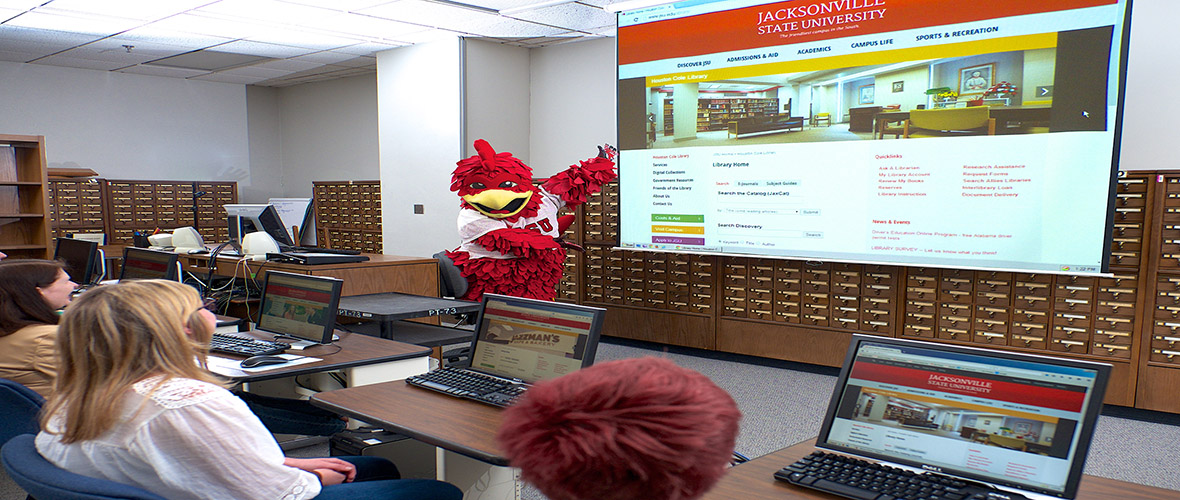
The Library offers Library Instruction to all individual patrons, classes, or groups that request these services. See the Library Orientation and Bibliographic Instruction section of the Policy and Procedures Manual for more information. Use the Library Instruction Request Form to schedule an instruction session. Contact Ms. Jodi Poe (jpoe@jsu.edu or 256.782.8103), Head of Library Services, for more information about our Library Instruction service.
Library instruction refers to single or multiple class sessions taught by subject specialist library faculty that introduce students to library research strategies and the basic information sources needed for effective use of the library. Library instruction sessions are designed for both a basic introduction to the university library, and to complement particular courses or fields of study. Instruction covers use of the databases to which the Library subscribes, the Library Catalog, the Houston Cole Library's website, subject-specific print indexes and abstracting services, major bibliographies and reference tools, as well as appropriate remote sources accessible on the World Wide Web, and from commercial information providers. Procedures for the retrieval and use of information and materials are also covered.
It is the policy of the Houston Cole Library to offer library orientation and library instruction to all individual patrons, classes, or groups that request these services, if the request is done in a timely manner and a librarian is available. Library orientation is designed to introduce new or potential patrons to the collection, facilities, organization, and services of the Houston Cole Library. Library instruction is designed to promote information literacy by teaching library patrons the organization and structure of information, and the variety of research methodologies employed to access relevant information in an effective, efficient, and timely manner, thus providing a foundation for contemporary and lifelong learning.
Library instruction can help students with any or all of the following:
- Understanding the use of the library's online system as well as remote catalogs
- Identifying and critically evaluating information in various formats available from a variety of local and remote sources including the World Wide Web
- Focusing and narrowing a topic
- Locating materials on a specific subject
- Recognizing scholarly vs. popular materials
- Using current as well as older materials
- Finding statistics, documents, and other sources, both electronic and in print
- Overcoming library anxiety
- Improving communication with library faculty regarding their information needs
Through instruction in the use of a wide range of library resources, students will be better able to complete more thoughtful, interesting, and scholarly research projects.
Classes are generally taught in one of the Library's two instruction classrooms - in the main lab in the basement or in 10-B on the 10th floor. There are occasions when the session must take place on a subject floor.
- The Main Lab has an instructor's workstation with a projector and 30 student computers for hands-on experience. There is additional seating around the room, but those do not have computers.
- 10-B has an instructor's workstation with a projector and two whiteboards. The room has tables and chairs for 30 plus 15 additional chairs around the parameter of the room. This space is lecture-style, so there are no computers for the students to use.
Library faculty are interested in becoming active partners in integrating information resources directly into classroom, and individual learning by involvement with classroom faculty at the initial stages of planning for library instruction. They are available to consult on assignment design and implementation to assure that the objectives of any library assignment are realistic and appropriate, given available source materials and other library resources. Please call the appropriate library faculty member (see list below) for advice as early as possible in planning a library assignment.
Library instruction should be scheduled as far in advance as possible to allow adequate preparation by the library faculty member involved. Timing is everything; students get the most out of library instruction if the session is presented on a date to closely coincide with the point of need for information. Once the session is scheduled, library faculty prepare their instruction and appropriate accompanying written materials in consultation with the instructor, taking into account the focus of the course, details of the students' assignments, and what sources should be presented in the sessions.
Faculty should arrange well in advance for library instruction for their classes by submitting the Library Instruction Request Form or by contacting the appropriate subject specialist librarian.
For more information about library instruction, please contact Mr. John Bruce Upchurch: jupchurch@jsu.edu; (256) 782-5252.